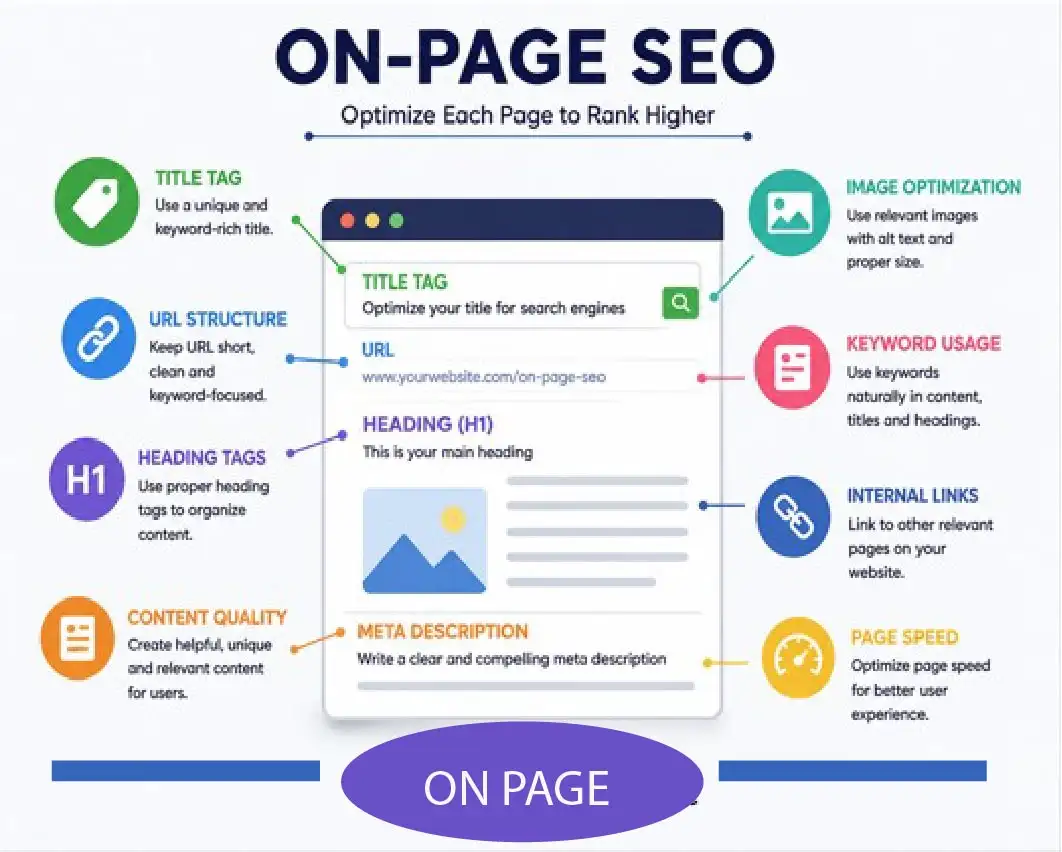
On Page SEO is the process of organizing and improving each webpage of a website in such a way that search engines like Google can easily understand the page and it is easy for the user to find information. Simply put, On Page SEO is the process of organizing the things inside your website that are important for SEO.
A good website is not just about being beautiful. The content, title, heading, image, URL, keyword and other elements also need to be organized correctly. If these are correct, the search engine can easily understand the content of your page and the chance of showing the page to the right user increases.
Why is On Page SEO important?
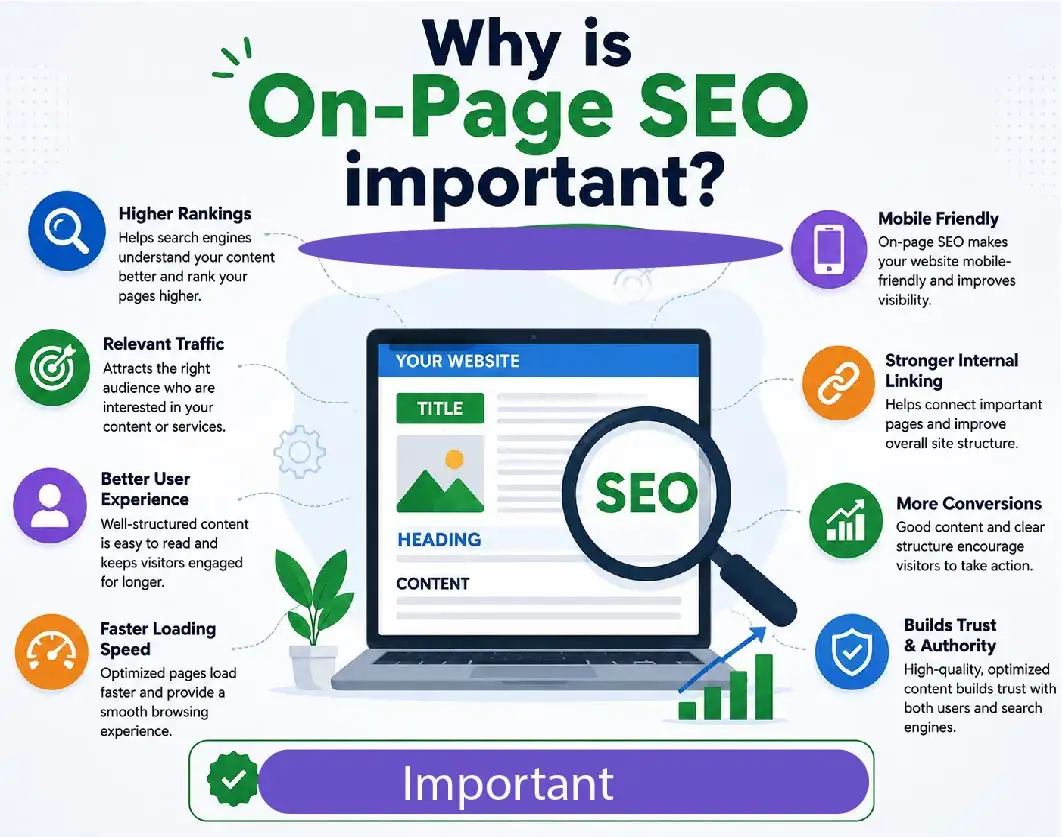
These days, when search engines are the first place people go to look for any information product or service. The page might have good information on your website, but if it is not SEO friendly then it would be hard for people to find.
On Page SEO is basically making your website easily understandable by both search engines as well as readers. It assists in making the material better and provides an excellent user experience.
Let us assume you have a website about kitchen products and there is an article on it. Details regarding coffee maker, oven, blender or juicer. However, the title, heading and content are not aligned perfectly that makes it hard for search engine to know what is in the page.
So, along with good content, it is also done the best On Page SEO.
Keyword Research and On Page SEO
Keywords are an important component of On Page SEO. Content is written around what people are searching for online wsearch.
But keywords are not about building sentences by repeating the same words. This is undesirable for readability and poor SEO practice. Instead, keywords need to be incorporated naturally as the situation demands.
If it is a cooking appliance page then influential words including coffee maker, blender and juicer, oven, etc. This will help a reader easily scan the page for the information they need and a search engine too, to see what the page is about.
Keyword Density
The frequency or how many times a specific keyword appears in a piece of content. Keyword should be consistent and not excessive For SEO. In general, you can start with 1 per 100 words and adjust-A little more up to your requirement. In an ideal world, 5 clear use cases/1000 words of content is perfect.
Using the Title Tag Correctly
Webpage Title Tag: The title of the webpage This provides search engines and users with knowledge of what the page contains. A title have to become eye catching and short and it must contain primary keyword .
Example:
What is On-Page SEO? A step-by-step guide in plain english
If a reader sees this kind of title, he/she can already understand what the page will contain.
Perfectly Using Heading
Heading is part used to split bigger content into smaller parts. This enables the reader to access relevant information in minimal time.
Generally the H1 is used for main heading of a page. Then H2 and H3 can be used to separate the sections on two different topics.
For instance, while writing On-Page SEO you can use:
What is On Page SEO?
Why is On Page SEO important?
How to use keywords?
What is Meta Description?
What is Image SEO?
What is Internal Linking?
Much more readable, if you structure it as.
The Importance of Meta Description
Meta Description: A short description of the web page. It is typically displayed below the title in search results.
A good meta desc will give the reader a reason to click into that page. As a result, it must give a high level overview of what the page is about.
Free Meta Description — It is better to have the reader understand in few words that there is what he needs on the page.
Keep the URL simple
Website URL is also take part of On Page SEO. The user and the search engine would benefit from a simpler and clearer URL.
For example:
example.com/on page-seo
You can guess, with this kind of URL what the page is about.
Better to avoid using extra numbers, needless words or difficult URLs.
Perfect Image SEO
You not only need to perform SEO for the text but also while reviewing the images on website procedures. Ensure the file name, alt text and size of image is being used appropriately.
For example, you have an image of a coffee maker on your kitchen appliances page. If the name of file picture does not matter, it can simply change and give a descriptive name.
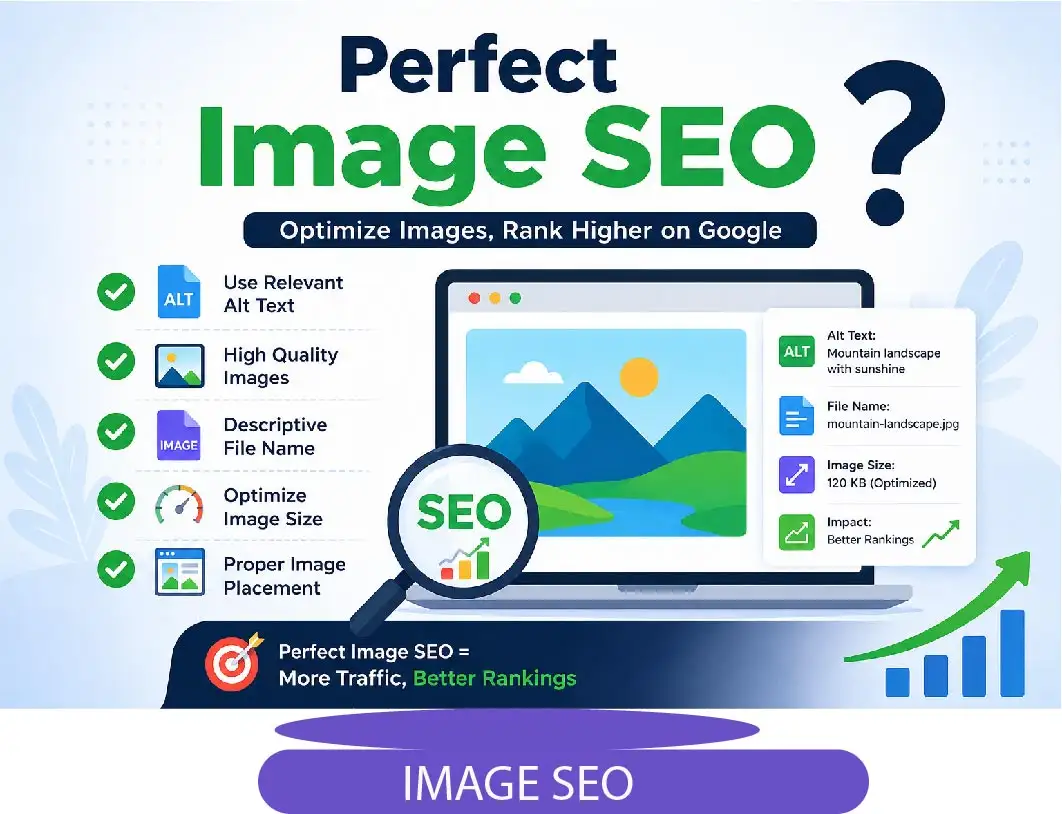
Likewise, for images of sink, cookwares, oven,and range hood, knife and blender/juicer etc it is better to give appropriate alt text.
This information, along with other image alt text and content helps the search engine understand more easily what the picture is about, but also makes it generally easier for people with disabilities to discover your page.
Doing Internal Linking
Internal linking is linking from one page of the same website to another.
Suppose, one of your pages discusses “Kitchen Appliances”. There you can link to a separate page with details about oven. Similarly, if you have separate content about blender or juicer, you can also link to them.
Internal linking helps the reader read more information on your website. It also helps search engines understand the relationship between different pages of your website.
Content qualities factor
On Page SEO is not only about keyword research. Providing value to your reader.
Your writing is such that the reader should get a one-line answer to his question. Without having to inflate the content adding wordiness.
So here is the situation — If someone is looking for “best kitchen appliances” then just mentioning the name of the product will not suffice. Simple explanation of what a product is used for, how to choose it and other factors that should be taken into account.
Mobile-Friendly Website
Most people nowadays work on websites using their mobile phones. Thus, avoiding such things we must make our websites of good shape and appearance on every device—mobile, tablet and computer.
Users leave the webpage if it is too small, images are fuzzy, and pages takes over a few seconds to open. Besides this SEO, user experience also needs to be taken care of.
Paying attention to Page Speed
If it takes too long for a page to open, there is a chance that the user will be annoyed. Consequently, the loading speed of it should be good.
Oversized images, additional short codes and plugins cause sluggish response time. These, you should only limit when necessary.
If a fast website is good for the user, then an overall better SEO performance is not just possible with it
Simple Checklist for On-Page SEO
- Before actually publishing a page you can monitor:
- Is the page an attention-grabbing title?
- Does the body content can use main keyword naturally?
- Is the heading used correctly?
- Is the meta description written?
- Is the URL simple and clear?
- Is the alt text relevant to the image?
- Are there internal links that lead to the right pages?
- Is the content simple to read?
- How well does the page show when viewed on a mobile device?
- Is the page loading quickly?
Final Words
On Page SEO is not a difficult subject. Its main purpose is to create good content in simple language, use the right keywords and arrange different parts of the webpage beautifully.
A good SEO page is not just about having keywords. It should have the necessary information of the reader, clear heading, good title, simple URL, appropriate image, internal linking and good user experience.
If your website is about kitchen or kitchen appliances, then you can create different and informative content on different topics like coffee maker, sink, cookwares, oven, Range hood, knife, strainer, blender and juicer. Applying the right On Page SEO on each page can make your website more beautiful, user-friendly and search engine-friendly.
The most important thing is—write content for people first, not for SEO. If the reader can easily understand your writing and get the necessary answers, then that is one of the biggest successes of good SEO content.
FAQ
Q: can Now the real reason Keyword Density be critical to On-Page SEO?
A: Keyword Density: Number of times a keyword used in content. Keywords should be used normally. Overusing comparison keywords also makes the content struggle to read between the lines, which is essential for good SEO practice.
Q: How Title, Heading and Meta Description Play Their Part in On-Page SEO?
A: Title Related to Subject of the page Heading Dividing Content of the Page into Parts Meta Description Giving Brief Information About what is on the Page. Used well, these drugs make the page clearer and better looking.
Q: How Image SEO and Internal Linking helps?
A: Also, file name and Alt text helps search engines to understand the context of the image. Whereas internal linking, however, can take you from one page of the same website to another. This not only aids the user in gaining further context but helps search engines understand how pages are related to each other.